Showing posts with label zo. Show all posts

translation: cheraw and the mizo


This was written as a piece meant to generate discussion on the forum, and not as an article, which explains the almost bullet-point style. I will try and keep up with the responses and add any further information I can find. The context is the intense discussion surrounding the Guinness record made by Mizoram (and here) in a bamboo dance called the Cheraw, elements of which we share with other south east Asian cultures.

The original piece here, and the author's blog here.

Particular thanks also to zozem and peer gynt, without whose help I would have been unable to complete this translation.
 

                     Cheraw and the Mizo

                                        -VaiVa

I’m not going to speak of whether we have or have not made a Guinness World Record in a bamboo dance. I think we have said all we wanted to. As for me, I want to know how Cheraw became our tribe’s dance, and since when this has become part of our culture and lifestyle. I’ll say what I know of it, you can then add what you know. I think the people at misual.com might profit more from this discussion than from discussions about bamboo-dances and World Records.

I have not heard of the Cheraw being danced at the Chapchar Kut. Somewhat like the Sawlakia, this was one of the dances of the Pawi before we came west (from Burma). Though I don’t have documented proof of this, I’m going to tell you what I’ve heard. I have not heard a clear explanation of how the word ‘Cheraw’ came to be used. It has many names. As far as I know, in the Pawi language, ‘Cheraw’ means ‘to move oneself around’. I have also heard this (dance) called “Hreichhun Zai”, “Ramkhat lak” and “Ngam lam”. It is also said that it was popularly called “Cheural Lam” before we crossed the Tiau river (between Burma and Mizoram), and that those that came west called it Cheraw.

Our Pawi siblings don’t use the term ‘Kan’ (cross) when referring to dancing Cheraw, they use ‘Tlawh’ (kick). I have also never heard of Cheraw being danced at the Chapchar Kut. The reason they dance this today seems to be as part of a show of our culture. Cheraw (known as Ngam Lam) was danced at the time of Buhza Aih* and Mim Kut.**

It seems the Pawi call Buhza Aih ‘Hrangza Tlawh’. You cannot throw a Buhza feast/Aih just because you’re already wealthy– you should have been blessed with a Buhza harvest consecutively for 10 years for you to be able to throw a feast. My father told me “In your grandfather’s Buhza Aih year of 1956, they definitely danced the Cheraw. They sang Cheraw songs, though men did not sing.”

Mim Kut was observed in Thitin month (August). Cheraw was also danced so that the spirit of a mother who dies in childbirth could pass peacefully.

Nowadays many different ways (steps) of dancing the Cheraw have emerged. Each place has its own way of dancing the Cheraw. Bualpui lam and Buhza Aih Lam seem to be among the more popular ones (steps). Apparently the dance steps that the Arts & Culture department has introduced is a conglomerate of steps taken from various areas, arranged in the most pleasing way. Pu Tlangrema from Hnahlan seems to have had a lot to do with these standardised steps.


NOTES:
* Buhza Aih/Ai: A feast given by a family for the whole village when they have been blessed with a surplus harvest. Buhza would have come from the fact that to have/throw such a feast, you should have reaped more than a 100 sacks of paddy, which is usually far more than the family can eat/keep/manage. This is a time of feasting for the whole village, with meat and zu (rice-beer).
   Literally, Buh phur Za = 100 sack loads of rice grain 
   1 Buh phur = approx. 3 tins of buh hum (paddy)
   1 Tin of of buh fai = 6-7 kg

** A festival that follows the (mim/vaimim) maize harvest, usually around September. Part of the celebration involved force feeding one another with eggs and other food in the graveyard. 

translations: intro


As part of an expression of my obsession with Access, I am trying to translate articles/pieces from a popular Mizo website called mi(sual).com into English.
 
Why translation? For two reasons.

One, there are quite a few people like me brought up on the fringes of
or outside Zo culture. Some of us barely know the language, but still wish to be a part of our culture and claim our heritage. Others know the language, but are slow readers and much more fluent in English. Still others are not the most interested because of the language acting as a barrier in getting to know Zo culture better. Most importantly, then, these translations are for ‘us’.

Second, much of the writing (in English) about the Zo tribes has been
by others, from the early British missionaries and colonialists to more contemporary journalists in Indian papers like The Telegraph and Tehelka. While I would not deny the immense good these writings have done (the missionaries gave us writing) I believe we should also represent ourselves. While many bloggers are already doing this, my particular concern is with the opinions, ideas and information in the Mizo language and therefore not accessible to the larger world.

Having said that, the choice of articles to translate is fairly arbitrary, and are influenced by my personal interests (culture, art etc.), length of the piece (my own Mizo skills are minimal) and the time I have available. I would welcome more help with translating more pieces, maybe eventually in the form of a Wiki. Please also feel free to correct my translation where you feel it is inadequate.


Disclaimer: I do not necessarily agree (or disagree) with the opinions
of those I try to translate, though I find the piece interesting. As far as possible, I will edit only to illustrate/explain what the author is talking about. This may mean there is a stiffness of language I apologise in advance for; the fault is with me, not the author.


markets vs. culture


We stopped and watched a street musical performance today, by a chap playing the various Andean pipes in time to recorded music. Dressed in ‘red-indian’ outfits, with the feathers and the beads, one person played the pipes, while the other sold CDs of the same music. The Andean flutes played well are a treat to hear, and a must listen for anyone interested in softer music. There was no doubt, he played well. Among other pieces, he played Chiquitita, the old ABBA classic, and El Condor Pasa, a tune made famous by Simon and Garfunkel.

The performance tore my heart.

On the one hand (and this is going to be a post of many hands) the cultural observer in me laughs at the irony of a ‘native’ peddling music that is an indigenisation of an Americanised pop culture version of indigenous music. El Condor Pasa was popularised by Simon and Garfunkel, but was composed by Peruvian composer Daniel Alomia Robles. The version playing today, however, sounded (the guitar plucking) very much like the S and G song. The cultural observer in me also smirks a little unkindly at the use of the ‘feathers-and-beads’ artifice to attract tourist attention and make sales.

On the other hand, here are two young (?) men making honest money from tourists and ‘westerners’ who can well afford it. While there is artifice, it is not dishonest, and the artifice is no worse than the mildest advertisements we see on TV every day. In the best traditions of movie making, these two men were giving people what they wanted to see, and there is nothing wrong in that, is there? They are also being entrepreneurial, and avoiding dependence on taxpayer funded social security, if there is such where they come from. The artist in me knows how hard it is to make anything like a living from my art, and when I work for a corporation, am I not guilty of the same artifice, if not worse?

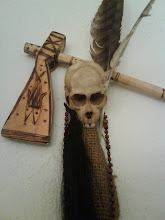
On yet another hand, it hurts me, as a tribal myself, that we are reduced to peddling our culture on the streets to make ends meet. While I understand very well the attraction of feathers and skulls (having a decent collection myself), I find their use in promoting some sort of ‘tribal’ exotica pathetic, if not downright offensive. Are cultures something to be so easily peddled on the street? I feel quite the same when I see young boys dressed as Krishna-avatar begging on the streets of Bengaluru. Interestingly, though the Zo are a very musical group, the khuang (drum) of tradition is still only used in church, maintaining, somehow its sacred quality, and is yet to be used in the production of commercial music.

Then again (that’s the fourth hand in case you’re counting) is it very different when the North East Indian tribes put on our costumes and ‘perform’ our dances on stage for fat-ass dignitaries to gawk at? However, as an urbanite who has grown up away from my tribal homeland, I would hardly even be aware of these aspects of my culture if it were not for these performances I am deigning to scorn! Aren't such performances keeping elements of our cultures alive?

I’ll stop at five hands- you probably get the idea by now. While I understand and promote the idea that culture is not static, it does concern me that the marketplace is increasingly imposing on cultural expression, and may one day soon completely take over. Aren’t there some things that should be kept sacred?

Maybe there is hope, though. On the way home, we saw another irony- three scruffy teenagers practicing their skateboard skills in the office building of a large insurance corporation. Hopefully, as the markets take over our cultures, we will continue to find points of resistance, and develop new cultural expressions that challenge their dominance!

What do you think?